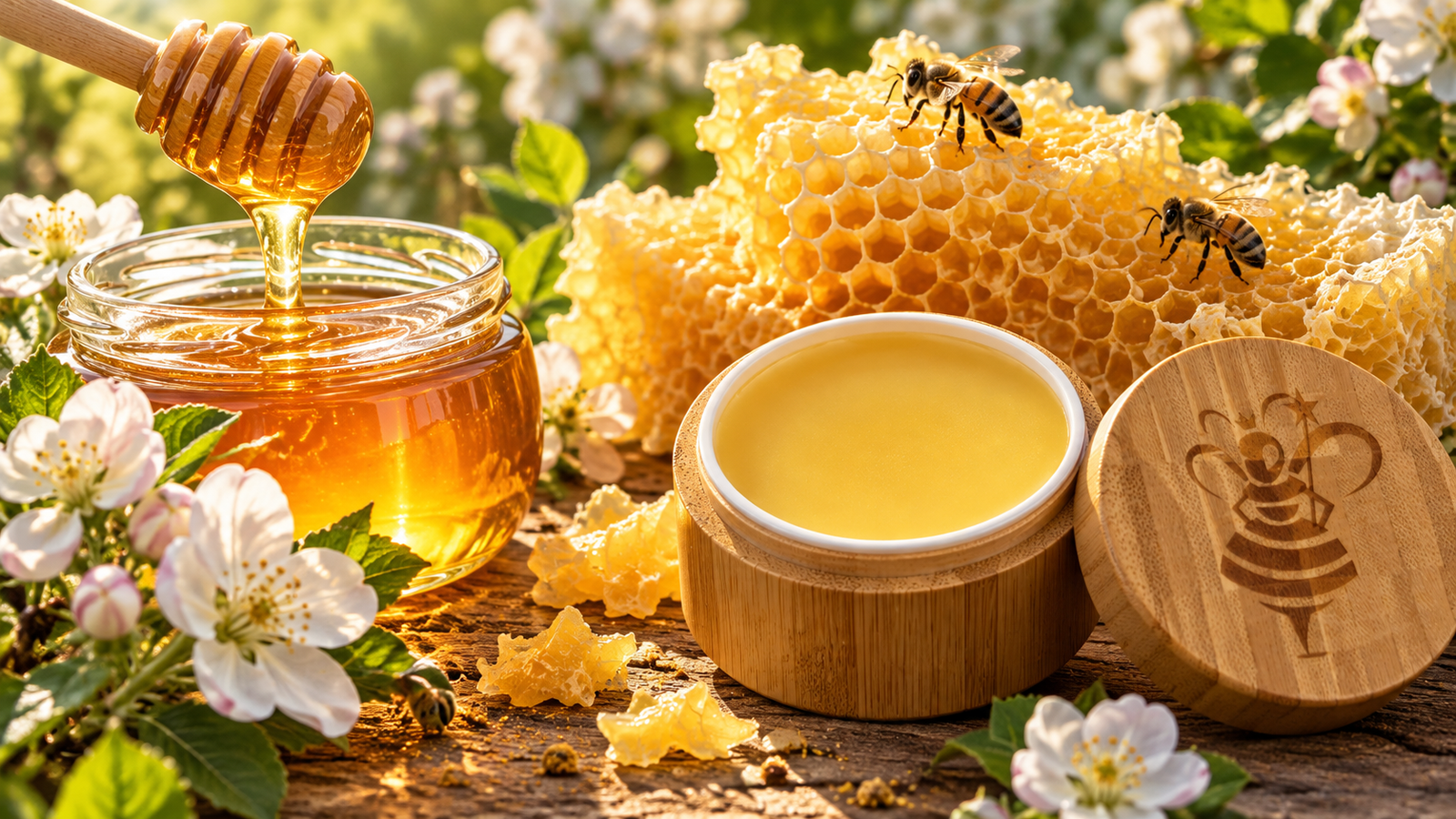
It sounds like an obvious combination.
We’re The Bee Fairy. We make natural beeswax balms. So surely our balms should contain honey too?
It’s a question we’ve been asked, and it’s a perfectly reasonable one.
Honey is an extraordinary natural substance and has been used in skincare for centuries. Research continues to investigate its humectant, moisturising and skin-conditioning properties.
So why don’t we add it to our balms?
The answer comes down to something that’s at the heart of the way we formulate every Bee Fairy product:
We don’t add an ingredient simply because it sounds good on the label. It needs to have a reason for being there.
Even in the hive, beeswax and honey have different jobs
We were reminded of this recently when a young visitor at one of our events asked us what beeswax actually is.
We explained it simply.
Bees produce wax to build their comb – a little like us making the jars and containers we need to store our food. The honey is then stored inside those wax cells.
Of course, what the bees create is considerably cleverer than a jar.
The familiar hexagonal cells fit together incredibly efficiently. The cells share walls, allowing the bees to create a strong structure while making very economical use of the wax they have worked hard to produce.
And honeycomb isn’t only a food cupboard.
The cells are used to store honey and pollen, but the comb is also the nursery in which the next generation of the colony develops.
So even naturally within the hive, beeswax and honey are separate substances doing very different jobs.
Honey is principally food for the colony.
Beeswax is a building material from which the bees create the structure used for food storage and for rearing their young.
We think that’s quite a useful way of looking at them when it comes to skincare too.
Just because beeswax and honey both originate from the hive doesn’t automatically mean they need to be combined in the same cosmetic product.
We formulate the whole balm – not individual ingredients
When we develop a Bee Fairy balm, we don’t start by asking:
“What ingredients would look impressive on the label?”
We start with:
“What do we want this balm to do?”
We then look at the range of ingredients available to us and select beeswax, oils, butters and other ingredients for the properties they can contribute to that particular formulation.
Just as importantly, we consider how those ingredients work together.
An ingredient can have wonderful properties on its own without necessarily improving a particular finished product.
That’s an important distinction.
Skincare marketing can sometimes become a long list of fashionable, unusual or appealing ingredients. But a longer ingredient list doesn’t automatically create a better product.
For us, every ingredient should earn its place.
Honey really does have interesting properties
Our decision not to put honey into our balms isn’t because we think there’s anything wrong with it.
Far from it.
Honey is a fascinating natural product. It consists mainly of naturally occurring sugars – particularly fructose and glucose – together with water and much smaller quantities of proteins, amino acids, enzymes, minerals, organic acids and plant-derived compounds.
And not all honey is identical.
Its composition can vary according to the flowers and plants visited by the bees, geographical origin, processing and storage.
That’s part of what makes real honey so interesting.
Scientific research has investigated honey for a wide range of properties. In skincare, there is particular interest in its humectant and skin-conditioning qualities.
There is evidence suggesting that honey can be a useful cosmetic ingredient, although the clinical research specifically around moisturisation is still relatively limited and results aren’t identical across all types of honey or studies.
So we’re certainly not saying that honey has no place in skincare.
The question we ask is slightly different:
Would adding honey actually improve the particular balm we’re making?
A tiny amount is still a tiny amount
It is possible to formulate cosmetics containing honey.
We could potentially add a small amount to a balm and then prominently advertise:
“WITH HONEY”
From a marketing perspective, that might sound wonderful alongside beeswax.
But that’s not a good enough reason for us to use it.
If we’re adding only a tiny amount of an ingredient, we want to understand what meaningful contribution that quantity is making to the finished product.
Adding something primarily because customers recognise the name – or because it makes the ingredient list sound more impressive – isn’t how we want to formulate.
If honey offered a clear and worthwhile advantage in a particular future formulation, that would be different.
We’d consider it on its merits, just as we would any other ingredient.
Honey and a water-free balm are very different things
Most of our traditional Bee Fairy balms are deliberately water-free formulations, based around beeswax combined with carefully selected plant oils and butters.
Honey is different.
Despite its thick, sticky texture, ordinary honey naturally contains water.
Honey itself is remarkably resistant to microbial spoilage. Its concentrated sugars, relatively low water activity, acidity and other characteristics create conditions in which many microorganisms struggle to grow.
But that doesn’t mean we can simply add honey to another cosmetic formulation and assume that the finished product will behave in exactly the same way.
Once we introduce a water-containing ingredient into an otherwise water-free balm, we have changed the formulation.
We then need to consider the finished product’s stability, microbiological quality and preservation requirements as part of its cosmetic safety assessment.
None of that means that a honey-containing balm can’t be formulated safely.
It absolutely can.
But we’d be making a different type of formulation – and we’d want a worthwhile reason for doing it.
What about powdered honey?
At first glance, there seems to be an obvious solution.
If the water in liquid honey complicates a water-free formulation, why not simply use powdered honey instead?
Again, it’s possible.
But it leads us to another question:
What exactly is the “honey powder” we’re adding?
Turning honey into a stable, free-flowing powder isn’t necessarily as simple as removing the water.
Because of honey’s naturally high concentration of sugars, it can be difficult to spray-dry successfully. Research into powdered honey therefore commonly involves carrier materials such as maltodextrin, gum arabic, whey protein or other ingredients to help create a usable powder.
That doesn’t make honey powder a bad ingredient.
But it does mean that, before using one, we’d want to know considerably more than the words “honey powder” on a specification sheet.
We’d want to ask:
Where did the original honey come from?
What was its botanical origin?
How much of the finished powder is actually honey?
Has a carrier been added, and if so, what is it?
How was the honey processed?
How much heat was involved?
And perhaps most importantly:
Do the particular qualities that made us interested in natural honey in the first place remain relevant in the processed ingredient we’re now adding to the balm?
For us, provenance and purpose matter.
Not all honey is the same
This is particularly relevant when people talk about the “benefits of honey” as though every jar contains an identical substance.
It doesn’t.
The composition of honey is influenced by its botanical and geographical origin.
The nectar collected from different plants contributes to differences between honeys, and processing and storage can affect some of honey’s naturally occurring components too.
That’s one of the reasons particular honeys can have different colours, aromas, flavours and chemical profiles.
So if we wanted to use honey because of particular naturally occurring properties, we’d also want to understand the honey’s origin and what happened to it before it reached our formulation.
Simply adding an anonymous honey-derived ingredient so that we could put HONEY on the label wouldn’t really fit our approach.
So why do we use beeswax but not honey?
This brings us back to the hive.
Although beeswax and honey are both produced through the extraordinary work of honey bees, they are fundamentally different materials performing different roles.
It’s much the same in our balms.
We don’t use beeswax simply because we’re called The Bee Fairy.
Beeswax has a job to do.
It forms an important part of the structure and character of our balms and works alongside the oils and butters we’ve selected to create the consistency, application and protective qualities we’re looking for.
Honey would have to earn its place in exactly the same way.
If we developed a future product where honey offered a genuine advantage and was appropriate to what we were trying to achieve, we’d consider using it.
But we wouldn’t add it to our existing balms simply because beeswax + honey sounds attractive on a label.
Every ingredient should have a purpose
And that really is the bigger story behind this article.
When we formulate a Bee Fairy balm, we’re not trying to create the longest possible ingredient list.
We’re not trying to include every fashionable natural ingredient.
And we’re certainly not adding something simply because it makes a product sound more impressive.
We start with the purpose of the balm.
Then we look at the properties we’re trying to achieve and select ingredients that can contribute towards those aims.
We consider what each ingredient brings to the formulation, how the ingredients work together, how the finished balm feels and applies, its stability and safety, and whether everything we’ve included has a worthwhile reason for being there.
Sometimes that means using an ingredient people expect.
Sometimes it means leaving one out.
Honey is a wonderful product of the hive.
We just don’t believe that being wonderful automatically means it belongs in every Bee Fairy balm.
Why We Formulate This Way
This article is part of our Why We Formulate This Way series, where we’ll look behind our ingredient lists and explain some of the decisions we make when developing The Bee Fairy balms.
We’ll look at the ingredients we use, some that we don’t, and – most importantly – why.
Next, we’ll answer a question that’s right at the heart of The Bee Fairy:
Leave a Reply